Return of the Thin Man: Two never-before-published novellas featuring Nick & Nora Charles by Hammett Dashiell
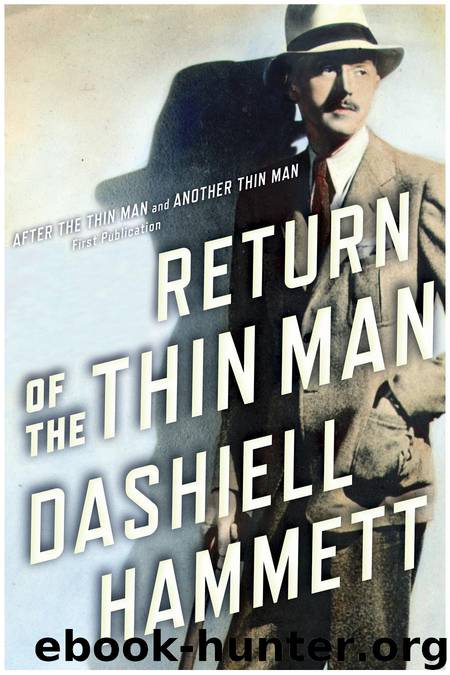
Author:Hammett, Dashiell [Hammett, Dashiell]
Language: eng
Format: mobi, epub
Publisher: Grove/Atlantic, Inc.
Published: 2012-11-05T16:00:00+00:00
AFTER THE THIN MAN
Afterword
In the opening frames of After the Thin Man, a billowing locomotive speeds through space and time with turns of night and day, and rushing American landscapes. The two and a half years that passed between the release of the original Thin Man film, in May of 1934, and its first sequel, released on Christmas Day 1936, evaporate in twenty seconds. Nick and Nora Charles, who had celebrated Christmas in New York, arrive just in time for New Year’s Eve in San Francisco.
At its core, The Thin Man’s sequel remains faithful to both Hammett’s original story and MGM’s original film adaptation. After the Thin Man, wrote Norbert Lusk in the Los Angeles Times, “succeeds in recapturing and carrying on the charm and originality of Nick and Nora Charles, who set a fashion in characterization all their own.” As Hunt Stromberg insisted, “Nick is always the same!—he’s a—CHARACTER.” And Nora remains his inimitable wife, friend, and foil. Important, the voices of The Thin Man also stay true. The Hacketts preserved Hammett’s quirky dialogue, with its rare blend of silly and cynical, sloshed and smart. “Have you ever been thrown out of a place, Mr. Charles?” threatens Dancer. “How many places was it up to yesterday, Mrs. Charles?” asks Nick. “How many places have you been in, Mr. Charles?” replies Nora. As in the first Thin Man—and as in John Huston’s 1941 adaptation of The Maltese Falcon—sizeable blocks of Hammett’s conversations are transferred undisturbed. Hollywood’s studios hired Hammett because he knew how to write dialogue that rang true, amused, and informed. Shrewd filmmakers didn’t muddle it.
Hunt Stromberg stressed another constant in his Thin Man project—the inherent tension between Nick and Nora’s personal histories. Portrayals of “his” and “her” people “should be of exactly the opposite type and tempo,” Stromberg said, so that “contrast between the two backgrounds will become more poignant.” Nick was a man of the people, with all their intemperate foibles. Nora was a product of the moneyed upper class, and while she was intrigued by Nick’s world, she was not insensible to its offenses. The surprise party at the Charles’s home, the dinner party at the Forrests’, and encounters with Nick’s criminal acquaintances amplify the contrast. Nora’s raised eyebrows and the couple’s furtive banter make good comedy. Their ability to transform social dissonance into connubial delight also reflects on the economic realities of the Depression Era, when moviegoers welcomed an imaginative world in which class barriers were permeable and wealth was not a precondition of happiness. Nick appropriated Nora’s glamorous lifestyle, but his low-life friends had a lot of fun, too.
There are, of course, significant differences between After the Thin Man’s screen story and its final production. Fewer changes than might be expected can be attributed to the Production Code Administration’s censorship. While Joseph Breen, head of the PCA, had said that “It will be necessary to limit all unnecessary drinking to an absolute minimum,” Nick, Nora, and the rest indulge liberally throughout the film. Breen
Download
Return of the Thin Man: Two never-before-published novellas featuring Nick & Nora Charles by Hammett Dashiell.epub
This site does not store any files on its server. We only index and link to content provided by other sites. Please contact the content providers to delete copyright contents if any and email us, we'll remove relevant links or contents immediately.
Crazy Rich Asians by Kevin Kwan(9262)
How to Bang a Billionaire by Alexis Hall(8128)
Giovanni's Room by James Baldwin(7302)
Win Bigly by Scott Adams(7172)
Little Fires Everywhere by Celeste Ng(7170)
Pachinko by Min Jin Lee(5668)
Tease (Temptation Series Book 4) by Ella Frank(5621)
The Fire Next Time by James Baldwin(5409)
The Perks of Being a Wallflower by Stephen Chbosky(4629)
China Rich Girlfriend by Kwan Kevin(4547)
Bluets by Maggie Nelson(4534)
First Position by Melissa Brayden(4512)
The Sympathizer by Viet Thanh Nguyen(4371)
Rich People Problems by Kevin Kwan(4273)
A Little Life (2015) by Hanya Yanagihara(4269)
Right Here, Right Now by Georgia Beers(4187)
Walking by Henry David Thoreau(3941)
Catherine Anderson - Comanche 03 by Indigo Blue(3610)
The Death of the Heart by Elizabeth Bowen(3596)
